Coming to Vietnam, I was hoping to learn more about the effect the United States has had on this beautiful country. I have read enough to know the pretext under which the United States invaded, the glorious mission we felt we had to accomplish, and the tragic losses suffered by both sides. Still, I only had a vague idea of what it means to be Viet Cong, and I was curious as to how, today, an American would be treated on Vietnamese soil.
Sara and I decided to go to War Remnants Museum our first day in Saigon. We went with our friend Sean, a brilliant FBI agent who was also staying at our hostel. I don’t think any of us were expecting three stories of brutally honest accounts of how the Vietnamese suffered during the “American War.” We decimated this country – its people and its landscape – killing over three million people (including two million civilians). Forty years later, we have seen people suffering from the effects of Agent Orange on the street. We have seen vast expanses of barren land where they should be lush forest.


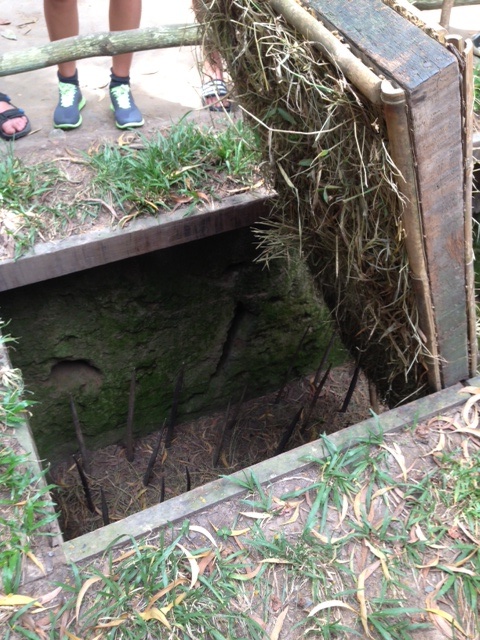

I have been thinking about how the veterans of the Vietnam War were treated upon returning the United States, and about how they are treated now; I am brought back home to the VA office and bar (what a terrible combination) that used to be on Newport Avenue. I cannot imagine returning from this socially and environmentally beautiful country, which was transformed into a vast and unforgiving hell, and the feelings of immense isolation that must have pervaded every veteran’s mind. I cannot imagine the feelings of those returning home today from the Middle East who are experiencing the same loneliness.
The tunnels got me thinking of one of the most profound books I have read in my life: Tim O’Brien’s The Things They Carried. Here is the passage that has been on my mind:
“They carried USO stationery and pencils and pens. They carried Sterno, safety pins, trip flares, signal flares, spools of wire, razor blades, chewing tobacco, liberated joss sticks and statuettes of the sniffing Buddha, candles, grease pencils, The Stars and Stripes, fingernail clippers, Psy Ops leaflets, bush hats, bolos, and much more. Twice a week, when the resupply choppers came in, they carried hot chow in green Mermite cans and large canvas bags filled with iced beer and soda pop. They carried plastic water containers, each with a two gallon capacity. Mitchell Sanders carried a set of starched tiger fatigues for special occasions. Henry Dobbins carried Black Flag insecticide. Dave Jensen carried empty sandbags that could be filled at night for added protection. Lee Strunk carried tanning lotion. Some things they carried in common. Taking turns, they carried the big PRC-77 scrambler radio, which weighed thirty pounds with its battery. They shared the weight of memory. They took up what others could no longer bear, Often, they carried each other, the wounded or weak. They carried infections. They carried chess sets, basketballs, Vietnamese English dictionaries, insignia of rank, Bronze Stars and Purple Hearts, plastic cards imprinted with the Code of Conduct. They carried diseases, among them malaria and dysentery. They carried lice and ringworm and leeches and paddy algae and various rots and molds. They carried the land itself. Vietnam, the place, the sod -a powdery orange-red dust that covered their boots and fatigues and faces. They carried the sky. The whole atmosphere, they carried it, the humidity, the monsoons, the stink of fungus and decay, all of it, they carried gravity. They moved like mules. By daylight they took sniper fire, at night they were mortared, but it was not battle, it was just the endless march, village to village, without purpose, nothing won or lost. They marched for the sake of the march. They plodded along slowly, dumbly, leaning forward against the heat, unthinking, all blood and bone, simple grunts, soldiering with their legs, toiling up the hills and down into the paddies and across the rivers and up again and down, just humping, one step and then the next and then another, but no volition, no will, because it was automatic, it was anatomy, and the war was entirely a matter of posture and carriage, the hump was everything, a kind of inertia, a kind of emptiness, a dullness of desire and intellect and conscience and hope and human sensibility. Their principles were in their feet. Their calculations were biological. They had no sense of strategy or mission. They searched the villages without knowing what to look for, nor caring, kicking over jars of rice, frisking children and old men, blowing tunnels, sometimes setting fires and sometimes not, then forming up and moving on to the next village, then other villages, where it would always be the same. They carried their own lives. The pressures were enormous. In the heat of early afternoon, they would remove their helmets and flak jackets, walking bare, which was dangerous but which helped ease the strain. They would often discard things along the route of march. Purely for comfort, they would throw away rations, blow their Claymores and grenades, no matter, because by nightfall the resupply choppers would arrive with more of the same, then a day or two later still more, fresh watermelons and crates of ammunition and sunglasses and woolen sweaters-the resources were stunning -sparklers for the Fourth of July, colored eggs for Easter. It was the great American war chest-the fruits of sciences, the smokestacks, the canneries, the arsenals at Hartford, the Minnesota forests, the machine shops, the vast fields of corn and wheat they carried like freight trains; they carried it on their backs and shoulders-and for all the ambiguities of Vietnam, all the mysteries and unknowns, there was at least the single abiding certainty that they would never be at a loss for things to carry.”
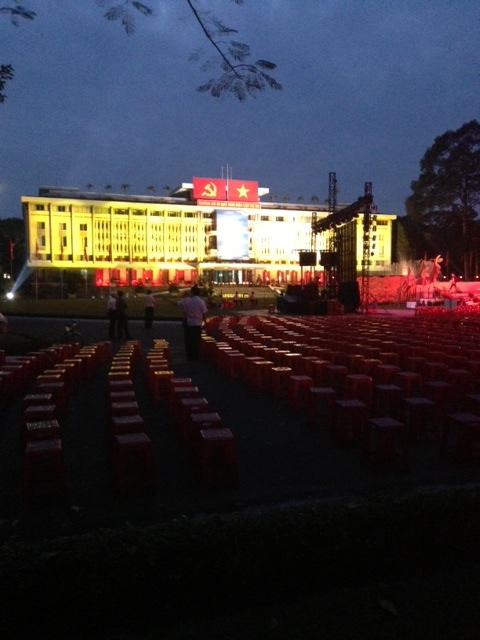
Today, Vietnam seems politically stagnant. The same red propaganda posters that I saw in Cuba decorate billboards here, with young army clad people staring into a bright future. However, there does not seem to be political unrest or many contentious political attitudes. Images of a withered Ho Chi Minh can be seen around the city, but people are too busy not getting hit by motorcycles to even notice the socialist disseminations speckled on the sides of buildings. I will endeavor to further explore the social-political attitudes of the Vietnamese in the next week. The book that I am currently reading, Frances Fitzgerald’s The Fire in the Lake, says that the political beliefs of the Vietnamese are just as present as they would be in any other country. However, the Vietnamese people have an entirely separate perspective of “self” than Americans. He says: “Time after time Westerners have been surprised by the suddenness of political change in Vietnam, by its seeming lack of motivation. But the motivation is always there. It is just that, given the commitment the Vietnamese have to their society, it remains hidden, and for the majority of the people, hidden even below the surface of consciousness, until in the old language the will of Heaven manifests itself and the success of the rebellion appears assured.”
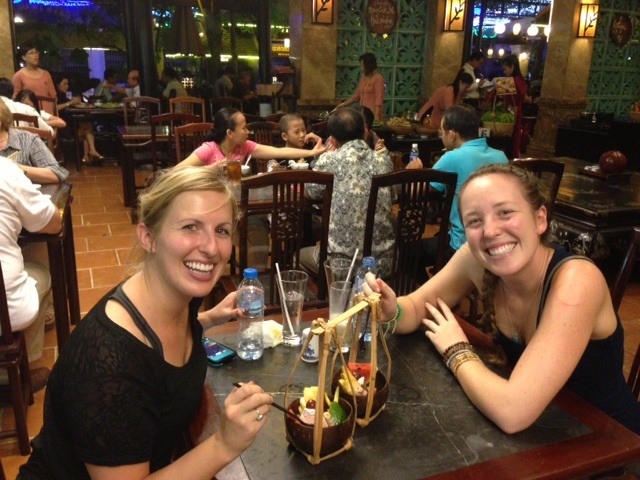
I couldn’t be more thankful to be with my friend Sara. She is curious, thoughtful, and always conscious of herself and others. Her kindness and adventurous spirit know no bounds! I am so honored to be her friend. She and I are planning on learning as much as we can on this transformational trip, about the world, each other, and ourselves. After our experiences on the first days of our trip, we are more determined than ever to be forces of peace and love in the world.
 caughtinannette
How poignant and profound- and most sobering. For those of us living through the Vietnam War, but never actually being there, your insight, experiences and sharing of Tim O’Brien’s passage is most moving. Reminds each of us that we are all part of the global community and our personal responsibility extends far outside our homes, families, cities and even our Country. My hope soars knowing that our World’s future rests in the hands of you, our precious daughters and sons. Continue forth, worthy and capable Ambassadors, with our love and our blessings.
I am hesitant to write anything at all Annette. You write so well and are full of wisdom, while I struggle to finish a complete sentence. I will be following your blog in the future, living vicariously thru you and your friend. I still remember that smiling third grader,sitting in the back of officiating class. I am proud to be your friend !!!! Stay safe and spread peace.
Terry, how wonderful to hear from you. Thank you for always being such an awesome person to the annoying third grader in the back! And thank you for reading, and for your kind words. Peace is abound. Sending so much love your way!
What a powerful story to include as the preface to this post. I can see your dad saying that to you… I love the way you tell stories!